How Do I Know Godmaster Downloaded On My Switch
🤔 What exercise I demand to know when mastering for Spotify?
🤔 What'due south the best book level for music on YouTube?
🤔 Why does my rail sound dissimilar when I upload information technology to Soundcloud?
🤔 How loud should I principal my track for iTunes?
If y'all don't know the answer to these questions your music might be affected when information technology'south presented to your fans. This postal service will give you the technical details to make sure your music sounds great on these platforms.

Near online platforms have a normalization process. This makes the music play back at a consistent volume. When you hear a 'quietly mastered' jazz track followed by a 'loudly mastered' dubstep track they maintain a abiding perceived loudness.

This is implemented so that the audience isn't always reaching for the volume command, and its generally considered to be a great thought.
Before I get into the juicy details of this post, it's important that yous understand what the 'LUFS' organisation is. LUFS stands for 'loudness units relative to full scale'. It's the nearly accurate way to to measure out loudness of sound. I recollect of it every bit a more precise RMS value.
Why Does Billowy My Master at a Specific LUFS Level Assistance my Music Stand Out on Online Platforms?
Spotify and Youtube stream sound at around -14 LUFS. If a track has a loudness level of -ix.5 LUFS (like AC DC Back In Blackness) both streaming platforms will decrease the book of that rail to effectually -14 LUFS.

This is Corking news. Information technology encourages artists to brand their music more dynamic and less compressed. If you're a producer, songwriter or artist you may have heard of the 'Loudness War'.

The loudness state of war credo is 'the louder your track, the meliorate it will sound to your listeners'. That is no longer necessarily the case. The Spotify scenario is explained further using pictures below.
Below in greenish we see a dynamic track measuring -14 LUFS. You can run into just by looking at the waveform that the transients are all in tact and have enough of room to exhale.

Below in red we see the same track but with compression and limiting bringing it up to -8 LUFS. Meet how the transients are now all squashed to the same level with no dynamic variation between them.
This makes the rails audio much flatter and less interesting. -8 LUFS is the aforementioned loudness equally many chart topping hits.

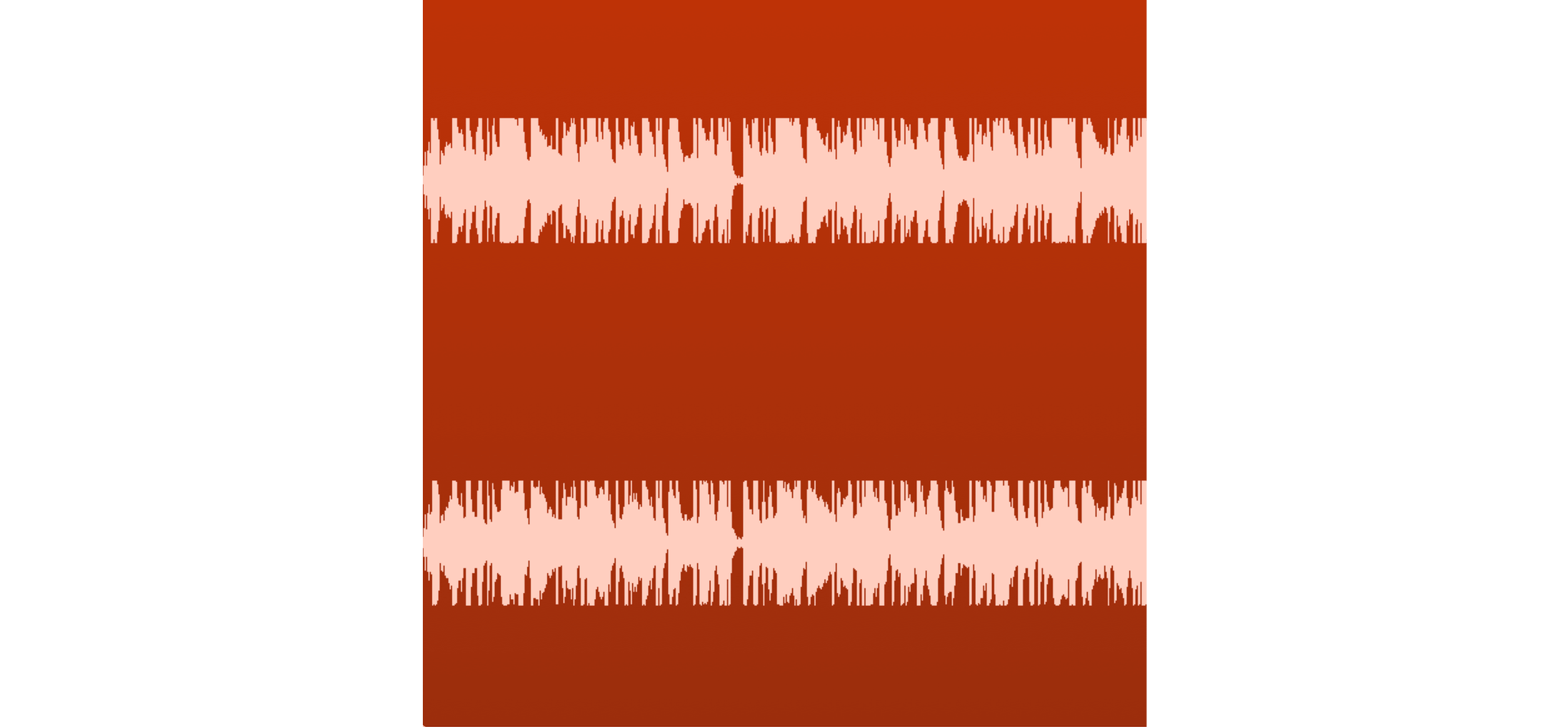
Below in red we see how the waveform would look when played back through Spotify. The track is streamed at effectually -14 LUFS which ways the tracks overall book is lowered, nonetheless the damage done by the excessive compression and limiting is irreversible.
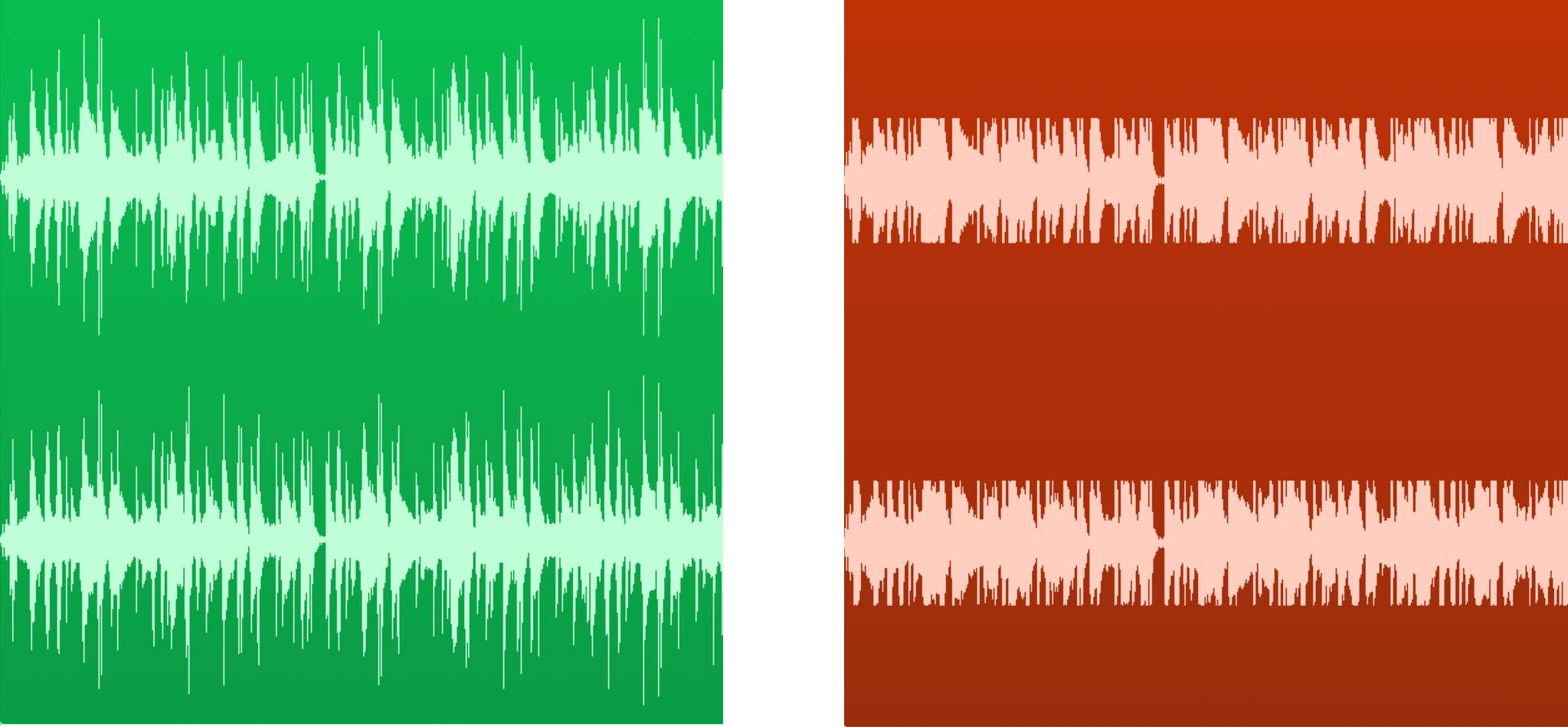
This track will lack the charisma and energy of its more dynamic analogue pictured in dark-green at the showtime of the case.
Here nosotros run across the same rails used in the examples above pictured side by side. They both have a loudness reading of -14 LUFS. The more than dynamic bounciness (green) will sound a lot better when played dorsum through online streaming services.
Loudness Targets For Streaming Platforms Nautical chart
Platform | Peak | Loudness | Dynamic Range |
| Spotify | -1.0 dBTP | -14 LUFS | >9DR |
| Apple Music | -1.0 dBTP | -16 LUFS (±one.0 LU) | >9DR |
| Apple Podcasts | -1.0 dBTP | -xvi LUFS (±1.0 LU) | >9DR |
| Amazon Music | -2.0dBTP | -nine to -13 LUFS | >9DR |
| Spotify Loud | -2 .0 dBTP | -11 LUFS | >9DR |
| Youtube | -1.0 dBTP | -13 to -xv LUFS | >9DR |
| Deezer | -1.0 dBTP | -14 to -16 LUFS | >9DR |
| CD | -0.1 dBTP | > -9 LUFS | >9DR |
| Club Play | -0.1 dBTP | -6 to -9 LUFS | >8DR |
| Soundcloud | -1.0 dBTP | -viii to -thirteen LUFS | >9DR |
Table Updated July 2021
So How Loud Should I Principal My Music?
You should main your music and so information technology sounds great to you! These figures aren't 'targets', but it's worth remembering that:
1. Louder music tin can announced to audio 'ameliorate', so be sure to level-friction match your master when referencing your favorite mixes in the studio (nosotros have an awesome plugin for that called REFERENCE, check it out!)

ii. Your music will get turned downward if it's louder than -14 LUFS. It will become turned upwards and potentially limited (to brand information technology louder without surpassing 0.0dB) if information technology's quieter than -14 LUFS. Going for a more than dynamic and punchy mix will sound improve than an over-compressed, distorted main. I personally like to proceed my clients music no louder than around -viii short-term LUFS during the loudest part of the song when I'm mastering for Spotify.
3. Spotify suggests leaving at least -1dBTP (decibels true peak) of headroom when submitting music and so they are optimized for the lossy formats. They suggest -2dBTP of headroom for loud track, as loud tracks take a greater chance of clipping during transcoding. Spotify streams audio using Ogg Vorbis and AAC files which are almost guaranteed to increase the meridian levels. For more info on true-peaks check out my post on How To Master Music To Get An Exact True Peak and LUFS Reading
4. Don't main too quiet! Amazon music turns louder songs down, but doesn't currently turn the tranquility tracks up. You wouldn't desire your song to lack free energy compared to the other tracks, then try to go along the overall integrated LUFS value at -16 LUFS or louder.
How Can I Measure LUFS In My rail?
Our plugin LEVELS has a number of features that will aid you get a fantastic mix. One of these features is a LUFS meter.

What Is The Best Volume To Utilise When Submitting Music To Soundcloud?
Soundcloud is different when it comes to loudness. Soundcloud doesn't normalize the volume playback on their tracks. But it's worth noting that they transcode all their audio to 128kbps MP3 for streaming. When the runway is transcoded, some clipping and baloney can have identify.
Louder tracks with higher peaks suffer the worst from the encoding and end up sounding crunchy and lacking clarity. Leave at least -1dBTP of headroom when mastering for Soundcloud and try not to become louder than -vii LUFS short-term.
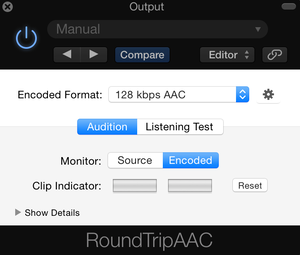
Apples plugin 'RoundtripAAC' lets y'all preview how your track volition sound in a lossy format. Information technology will besides tell you if your rails will clip in one case it has been converted for streaming. RoundTripAAC converts to AAC rather than MP3 just information technology will requite yous a good reference.
CONCLUSION
At that place is no need to compress and limit your music to the max to 'compete with other releases'. A dynamic and less squashed runway will brand your music stand up out from the rest on online streaming platforms.
Master your audio to a loudness that you feel best serves the music, but be aware that high summit levels and super-loud masters will give your listeners a sub-standard listening feel when they stream your sound.
Plugins Used In This Weblog

-

30-Twenty-four hour period Money Back Guarantee
-

Identifies bug and gives advice on how to set up
-

Keeps yous in your artistic period
-

View LEVELS Product
🌎 Overview: LEVELS is a metering plugin that identifies problems with your music'southward loudness, peaks, dynamic range and stereo spread.
⚠️ Problem Solved: Metering is boring and confusing, but necessary if you desire to create pro-sounding music. LEVELS was created to make metering unproblematic for artists who desire to stay in their artistic flow. If an issue is detected with your music, the problematic department will glow red. All green = no issues and you can get back to making music.
✅ Go Started: LEVELS should sit constantly on your master channel, after your limiter if y'all're mastering. Select the preset (Mixing, Mastering, Spotify, Order etc) then play your audio so LEVELS can analyse. Any department that turns red volition demand your attention.
🤩 Highlight i: Get your music sounding information technology's all-time on whatsoever playback platform.
🤩 Highlight 2: Hover your mouse over the section icons to become feedback on how to resolve the issues that LEVELS has identified.
LEVELS Walkthrough Video & Transmission
DOWNLOAD HERE
Posted by: cookthemy1976.blogspot.com